

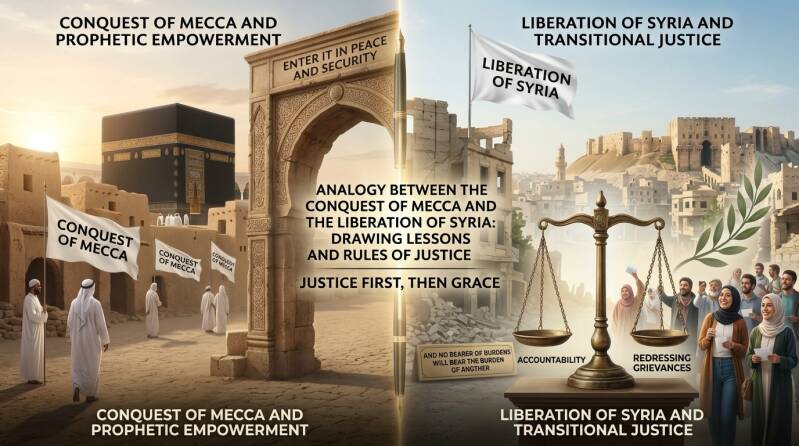
Between the Conquest of Mecca and the Liberation of Syria: A Foundational Study on the Rules of Analogy (Qiyas) and Transitional Justice
Introduction
In the context of major historical transformations, a methodological and Islamic legal (Shar'i) question arises regarding the permissibility of drawing an analogy (Qiyas) between the "Conquest of Mecca" and the "Liberation of Syria," and the resulting rulings concerning general amnesty, holding perpetrators accountable, recovering looted rights, and uncovering the fate of the forcibly disappeared. Rigorous scholarly investigation requires a precise distinction between literary or homiletic inspiration and juristic analogy (Qiyas Usuli) or legal application; for every context has its own jurisprudence, and every era has its own tools for achieving justice.
Section One: The Scale of Analogy Between the Conquest of Mecca and the Syrian Reality
First: Aspects of Permissibility (Literary Analogy and Drawing Lessons)
Drawing an analogy between the two events is valid from a literary and homiletic perspective. Here, what is intended is "taking heed" (I'tibar) and "seeking guidance" (Isti'nas) from the Prophetic example in reading God’s laws (Sunan) in history [1]. This is both legitimate and desirable, manifesting in two aspects:
- The Divine Law of Empowerment After Patience: Just as the Conquest of Mecca came as the culmination of years of patience, displacement, and trial, deliverance from tyranny arrives after immense sacrifices and long endurance. This inspires hope that the ultimate outcome belongs to truth, no matter how long the night of oppression lasts.
- The Ethics of Victory and Managing the Transitional Phase: The Conquest of Mecca represents the highest model of self-restraint when in a position of power, prioritizing the supreme public interest, avoiding indiscriminate revenge or unlawful bloodshed, and granting security to the people [2]. Any society emerging from a bitter conflict needs these moral and political principles to heal its wounds and build civil peace.
Second: Aspects of Prohibition and Difference (Juristic and Historical Analogy)
It is impermissible to literally project the rulings or details of the Conquest of Mecca onto the contemporary Syrian reality due to fundamental considerations:
- Absence of the Juristic Effective Cause ('Illah): Islamic legal analogy requires equality between the "original case" (Asl) and the "new case" (Far') in the unifying effective cause, rendering any "analogy despite a decisive difference" (Qiyas ma'a al-Fariq) invalid [3]. Such equality does not exist between a foundational event in the Prophetic biography (Sirah) and a contemporary national liberation revolution with its own international, legal, and social complexities.
- Difference in the Nature of the Conflict: The Conquest of Mecca was a conflict between a commissioned Prophet and a nascent Islamic state on one side, and the polytheists of Quraysh on the other (a conflict between faith and polytheism). In contrast, the conflict in Syria is a political, human rights, and social struggle between a people demanding their freedom and dignity and a tyrannical political regime. Broadly speaking, both sides are citizens of the same homeland and predominantly affiliate with Islam, which makes the characterization of the reality and its rulings entirely different [4].
- Difference in Resulting Juristic Rulings: The rulings enacted by the Prophet ﷺ in Mecca (such as the status of the Tulaqa' [those freed at the Conquest], the destruction of idols, or the special sanctity of Mecca) are Prophetic rulings tied to the specificity of time, place, and divine revelation [5]. Modern civil policies—such as issues of transitional justice, prosecuting perpetrators of crimes, and recovering looted rights—cannot be analogized to them. Indeed, the Prophet ﷺ himself excluded a group of chief criminals from the general amnesty due to the enormity of their crimes [6].
Section Two: Rules of Amnesty and Accountability in Islamic Jurisprudence
Islamic jurisprudence establishes a precise balance that combines the imperatives of justice and the fulfillment of rights with the objectives of tolerance and sparing bloodshed during transitional phases, through the following principles:
First: The Golden Rule (Distinguishing Between Public Right and Private Right)
The judicial and political system in Islam is built upon a strict distinction between two categories of rights [7]:
- Rights of Human Beings (Huquq al-'Ibad) are based on strictness and fulfillment (Mushahah): Neither the ruler, nor the judge, nor any political authority possesses the right to waive the claim of a person whose relative was murdered, whose property was seized, or whose honor was violated. The holder of the right is the injured party themselves (or their heirs). God Almighty says: "And whoever is killed unjustly - We have given his heir authority" [Al-Isra: 33].
- Rights of God (Huquq Allah / Public Right) are based on leniency and public interest (Musamahah): Matters relating to violating public order, being misled, or participating in civil strife without directly infringing upon a private life or property fall under the discretion of the ruler (Imam / legitimate authority) in accordance with the general welfare of the state, which may grant amnesty or commute penalties in such cases.
Second: Rules of Amnesty in Shari'ah-Oriented Governance (Al-Siyasah al-Shar'iyyah)
In Islamic governance, amnesty is not an emotional slogan thrown around recklessly; rather, it is an action bound by strict controls that prevent chaos and protect society [8]:
- It must not waive a human right: General amnesty covers political or organizational offenses affecting the state entity, and does not include bloodshed or looted property except with the consent of the rightful owners or through fair compensation that satisfies them.
- It must not lead to a greater harm (Mafsadah): If people know that an oppressor will escape punishment without accountability, it encourages the repetition of crimes or pushes the wronged to take the law into their own hands outside the legal framework, thereby threatening civil peace.
- Pairing amnesty with repentance and the restitution of grievances: God Almighty says: "Except for those who repent before you apprehend them" [Al-Ma'idah: 34]. Even after apprehension, sincere repentance requires absolving oneself of injustices and returning rights to their owners.
Third: The Jurisprudence of Civil Strife and Rebels — Distinguishing Between Leaders, Followers, and the Coerced
In the chapter on "Fighting Rebels and Civil Strife" (Qital Ahl al-Baghy wa al-Fitan), jurists categorize those involved in internal conflicts based on responsibility and intent into precise tiers [9]:
- Ringleaders of Strife and Leaders of Criminality: These are the ones who ignited the fire and planned the violations, bloodshed, and seizure of property. They are not covered by general political amnesty, and repentance alone does not absolve them of private criminal liability concerning human rights (retaliation/Qisas and compensation).
- Followers, Soldiers, and Employees (Misguided or Deceived): Those who entered the conflict out of conformity rather than choice, or were thrown into the furnace of strife without directly committing injustice. The default approach toward them is amnesty and leaving them in peace after securing their repentance and guaranteeing they will not return to aggression.
- Those Under Compelling (Complete) Coercion (Ikrah Mulji'): Anyone forced under threat of immediate death or severe, extreme bodily harm to commit a prohibited act (short of directly committing murder) is absolved of sin, based on the Almighty's saying: "Except for one who is forced [to renounce his religion] while his heart is secure in faith" [An-Nahl: 106], and the Prophet's ﷺ saying: "God has pardoned my nation for mistakes, forgetfulness, and what they are coerced into doing."
- Those Under Incomplete Coercion or Acting Out of Greed/Fear: Anyone who participated out of fear for their position or greed for status without a genuine threat to their life is sinful and criminally liable. The juristic maxim states: "Harm is not removed by causing another harm," and it is impermissible to ward off harm from oneself by inflicting injustice upon others.
- Direct Perpetrators of Murder or Torture (Intentional): Anyone who directly carried out murder, torture, or the usurpation of rights by choice cannot benefit from the defense of "following orders." According to Islamic criminal principles: "There is no obedience to a creature in disobedience to the Creator." An unlawful military or administrative order is void and does not exempt the perpetrator from retaliation (Qisas), blood money (Diyah), or the restitution of rights.
Section Three: Islamic Historical Models in Post-Conflict Management
The Islamic historical experience is rich with major milestones in which leadership combined the enforcement of justice with the sparing of blood:
- The Model of Imam Ali ibn Abi Talib (may God be pleased with him) after the Battle of the Camel (35 AH): He applied the principle of preserving rights and refraining from vindictiveness. He did not treat his opponents as fair game; their families were not enslaved, nor was their wealth taken as spoils. He ordered that no wounded person be finished off and no fleeing person be pursued, while keeping individual rights subject to the scales of the Shari'ah judiciary.
- The Model of Caliph Umar ibn Abd al-Aziz (may God have mercy on him): He adopted a policy of dismantling corruption networks, redressing grievances, and returning unjustly confiscated funds and land grants (beginning with himself and his own household). He dismissed oppressive governors and held them financially and administratively accountable without bloodshed or tribal vengeance, resulting in state stability and the prevalence of justice.
- The Model of Saladin (Salah al-Din al-Ayyubi) after the Liberation of Jerusalem (583 AH): He granted safety to those inside the city and allowed them to leave for a modest ransom. He and his brother personally paid the ransom for the poor and elderly out of their own private funds. Simultaneously, he recovered endowments (Awqaf) and public properties and handed them over to their rightful owners, setting an example of a just, moral victory far removed from blind revenge.
Section Four: A Comparison Between Juristic Heritage and Modern Transitional Justice Mechanisms
Modern transitional justice mechanisms converge with Islamic juristic heritage in their overarching objectives (preserving wealth, preserving life, redressing harm, and uncovering the truth), while complementing it in procedural and institutional tools:
First: The File of Looted and Confiscated Funds
Islamic jurisprudence in this domain is built upon a definitive rule: statutes of limitations do not extinguish a right, and the hand of a usurper or thief is a hand of liability (Yad Daman) whose obligation is only discharged through restitution or absolution:
- Juristic and Legal Characterization: Seizing property is classified in Islamic jurisprudence under usurpation (Ghasb), embezzlement of public funds (Ghulul), and consuming people's wealth unjustly. Whatever is taken through intimidation or state coercion carries the ruling of usurped property. In modern transitional justice, this corresponds to "systemic financial corruption" and "illicit acquisition of assets."
- The Principle of Restitution and Asset Tracing: In jurisprudence, this is governed by the maxim "The hand is liable for what it has taken until it returns it," and the maxim "Whoever finds their exact property has the strongest right to it," even if it has passed into the hands of a subsequent buyer. Modern equivalents include asset recovery laws, freezing accounts, pursuing laundered money, and voiding coerced sales contracts.
- Compensation for Damage or Alteration: Jurists mandate returning a like-for-like replacement or its monetary value if the usurped property has been consumed or altered, along with compensating for its lost utility throughout the period of usurpation (fair market rent / Ujrat al-Mithl). Modern equivalents include establishing national reparation funds financed by assets confiscated from corrupt figures to compensate victims and fund reconstruction.
- Property of Unknown Ownership: If reaching the owners of looted funds or their heirs proves impossible, the funds are directed in jurisprudence to public interests (the Public Treasury / Bayt al-Mal) with the intention of charity on behalf of the owners, so they do not remain in the hands of the oppressor. This aligns with directing assets of unknown ownership to the state's public treasury in modern systems.
Second: The File of the Missing and Forcibly Disappeared
Jurists dedicated an independent chapter titled "Rulings of the Missing Person" (Ahkam al-Mafqud) to safeguard their rights and the rights of their families:
- The Duty of Search and Investigation: Jurists obligate the judge or ruler to search, inquire, and investigate the whereabouts of a missing person using every available means of their era before issuing a ruling regarding them. Modernly, this is embodied in establishing independent national commissions for the missing, opening security archives, and utilizing databases and forensic medicine (DNA).
- Preserving the Rights of the Missing (Presumption of Continuity / Istishab al-Hal): A missing person is treated in jurisprudence under the rule of "presumption of the original state": they are considered alive regarding their own person and property. Thus, their inheritance is not divided, their assets are held by a trustee appointed by the judge, and their share of inheritance from others is suspended until their fate becomes clear. Modernly, this corresponds to freezing the legal status of the forcibly disappeared person's property and appointing a legal guardian to manage their family's affairs.
- Determining Fate (Timeframe): Jurists (particularly the Malikis and Hanbalis) distinguished between disappearance during peacetime and disappearance during war and civil strife (where death is probable, shortening the waiting period to four years or less based on circumstantial evidence). Modernly, this corresponds to issuing judicial death certificates after exhausting search and verification procedures to settle the civil and financial affairs of families.
- Psychological and Material Reparation for the Family: The judge mandates financial maintenance (Nafaqah) for the missing person's wife and children from their preserved wealth; if they have no wealth, it is paid from the Public Treasury to protect the family from destitution. Modernly, this corresponds to providing material, moral, and social support to the families of the missing and officially acknowledging their suffering.
Conclusion
Drawing moral inspiration from the Conquest of Mecca to promote values of tolerance, spare bloodshed, and build the future is praiseworthy—provided it is not used to obstruct the course of justice or waive the rights of the oppressed under the pretext of "Go, for you are the freed ones." The overarching Islamic principle is: "Justice first, then grace (Fadl)." Amnesty has no meaning before empowering the wronged to claim their rights; once the right is established and the victim is enabled to claim it, their subsequent pardon becomes a virtue that builds society, rather than a weakness that entrenches injustice. While juristic grounding provides the moral and religious legitimacy that grants these measures societal acceptance, modern mechanisms provide the institutional and technical tools necessary to apply them in a complex reality.
Footnotes and References
- See: Ibn Khaldun, Abd al-Rahman, Muqaddimat Ibn Khaldun, Chapter One (on the error of historians and preachers when they analogize the present to the past with exact correspondence without accounting for changing conditions, eras, and social solidarities, and the difference between taking heed from historical laws and literal comparison).
- See: Al-Ghazali, Muhammad, Fiqh al-Sirah, Chapter on the Conquest of Mecca (explaining how the Conquest serves as a moral school in tolerance, self-restraint when in power, and drawing lessons for callers to Islam and reformers).
- See on the conditions of analogy and the invalidity of analogy despite decisive differences: Al-Ghazali, Abu Hamid, Al-Mustasfa min 'Ilm al-Usul (section on the pillars of analogy and conditions of the effective cause); Ibn Qudamah al-Maqdisi, Rawdat al-Nazir wa Jannat al-Manazir (Chapter on Analogy, invalidators of the effective cause); Ibn Qayyim al-Jawziyyah, I'lam al-Muwaqqi'in 'an Rabb al-'Alamin (Vol. 1, explaining the conditions of sound analogy and the change of fatwa according to time, place, and circumstance); and Al-Shatibi, Abu Ishaq, Al-Muwafaqat fi Usul al-Shari'ah (Book of Objectives, section on "Verification of the Basis" / Tahqiq al-Manat).
- See on the juristic distinction between fighting polytheists and fighting rebels and internal conflicts: Al-Mawardi, Abu al-Hasan, Al-Ahkam al-Sultaniyyah wa al-Wilayat al-Diniyyah (Chapter Five: On the Command of Wars).
- See: Ibn Qayyim al-Jawziyyah, Zad al-Ma'ad fi Hady Khayr al-'Ibad (Vol. 3, Section: "On the Campaign of the Greatest Conquest," distinguishing between what belonged to the specificities of Mecca and Prophethood and what can be derived for politics and warfare).
- See: Ibn Hisham, Al-Sirah al-Nabawiyyah (events of the Conquest campaign in Ramadan, 8 AH, the story of the Tulaqa', and the names of the individuals whom the Prophet ﷺ ordered to be executed due to the enormity of their crimes); and Al-'Umari, Akram Diya', Al-Sirah al-Nabawiyyah al-Sahihah (an analytical study of the Conquest events and the dimensions of Prophetic amnesty).
- See: Ibn Taymiyyah, Taqi al-Din, Al-Siyasah al-Shar'iyyah fi Islah al-Ra'i wa al-Ra'iyyah (Chapter on Prescribed Punishments and Rights, explaining that the rights of God are built upon leniency upon repentance and public interest, whereas the rights of human beings are built upon strictness and fulfillment, and the ruler has no authority to waive them except with the consent of their owners).
- See: Ibn Qayyim al-Jawziyyah, Al-Turuq al-Hukmiyyah fi al-Siyasah al-Shar'iyyah (explaining that justice is the foundation upon which governance is built, and that suspending the redress of grievances under the pretext of tolerance corrupts both the land and the people).
- See on the rulings of rebels, civil strife, and liability for damaged rights: Ibn Qudamah al-Maqdisi, Al-Mughni (Book of Fighting Rebels, explaining the rulings of internal conflict, what political consequences are pardoned, and what guaranteed rights of blood and property are not pardoned).
Add comment
Comments